
The Novation Challenge

Larry Bridges
Head of STS Technical Services Hub / Dep. COO / CIO
Why Due Diligence Has Become the Critical Path in Aircraft Transactions
Aircraft novations have long been a core feature of the leasing market. They provide a well-established mechanism for transferring lease obligations between lessors, supporting portfolio management, capital recycling and strategic repositioning. The process itself is familiar.
What has changed is the environment in which novations are taking place. Transaction volumes have increased, expectations at each stage have evolved, and the operational infrastructure supporting these transactions has not always scaled at the same pace. The result is growing pressure on timelines, resources and, at times, on the relationships between stakeholders.
In our work supporting lessors and airlines globally, Shannon Technical Services sees novation workstreams across the full lifecycle, from early-stage records due diligence through to closing. This vantage point provides a clear view of where transactions move efficiently and where they begin to encounter friction. This article outlines those observations, with a particular focus on the due diligence workstream, and highlights practical ways the industry can reduce friction without compromising rigour.
The Market Context: Rising Volume, Rising Complexity
Several structural factors are driving increased novation activity. Aircraft delivery volumes are rising as OEM production stabilises and ramps up. Boeing’s delivery performance is looking healthier, and confidence in Airbus’s production ramp continues to build. According to IBA Insight, the financing requirement for new aircraft deliveries is projected to reach around $160 billion annually by 2030. That growing requirement is encouraging lessors to actively trade existing assets, freeing capital to participate in new sale-leaseback opportunities.
Mergers and acquisitions are adding further momentum. Recent large-scale transactions, including the consortium acquisition of Air Lease and DAE’s acquisition of Macquarie, will bring portfolio rationalisation as new owners reshape and potentially de-risk areas of their holdings. These consolidations generate significant trading activity, with novations forming a key part of the process.
Meanwhile, the extended lease cycles that followed the COVID period are beginning to unwind. Some of the larger lessors have signalled that their extension programmes are essentially complete, which means more aircraft will transition and more leases will turn over. Lessor-to-lessor trading, the category most directly associated with novations, has also increased. IBA Insight data shows that new lease placements have consistently outpaced lease ends, expanding the overall leased fleet and naturally increasing the volume of potential novation events.
These trends are indicative of a healthy and evolving market. The challenge lies in the fact that the supporting processes, resources and systems have not always kept pace with this growth.
Two Clocks, One Transaction
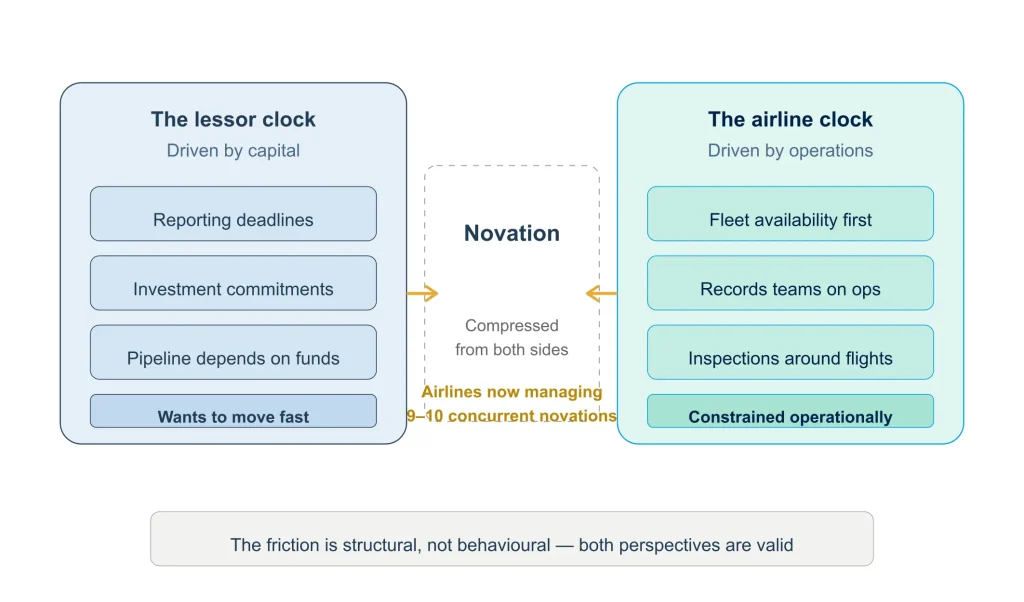
A consistent pattern across novations is the misalignment between lessor timelines and airline operational realities. For lessors, a novation is a capital event. Timelines are often linked to financial reporting cycles, investment commitments or onward transactions. Delays can have material commercial implications, not just for the immediate deal, but for the pipeline of transactions that depend on those funds being released.
For airlines, priorities are operational. Technical teams are focused on maintaining fleet availability, and novation activity must compete with day-to-day responsibilities. Records teams support active fleets rather than transaction pipelines, and inspections must be scheduled around aircraft utilisation.
As novation volumes increase, airlines are managing multiple concurrent requests. It is now common for lessors to encounter queueing; we have heard airlines tell an incoming lessor to join a queue of nine or ten novations already in progress. That is not an exaggeration. It reflects the sheer scale of activity that operational teams are now being asked to absorb.
Both perspectives are entirely valid. However, the result is two different timelines operating within a single transaction. The lessor is often looking to move quickly; the airline is constrained operationally. The novation sits right in the middle of that tension, and much of the friction we observe stems from this structural misalignment.
Due Diligence: The Critical Pressure Point
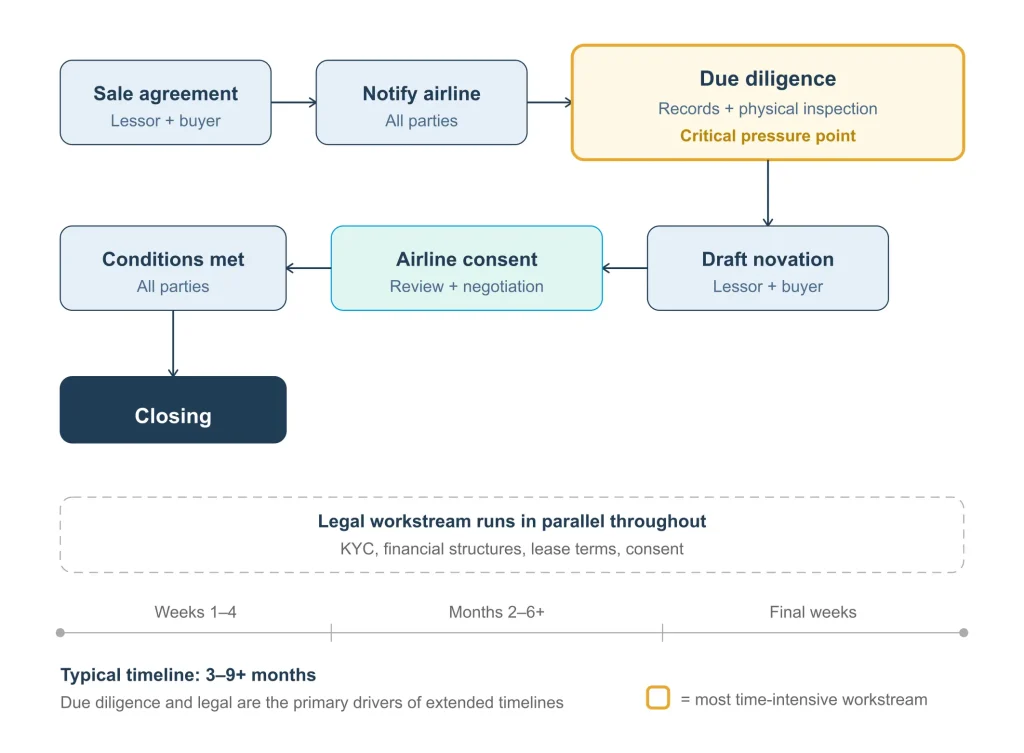
Across the novation process, due diligence has become the most time-intensive and complex workstream.
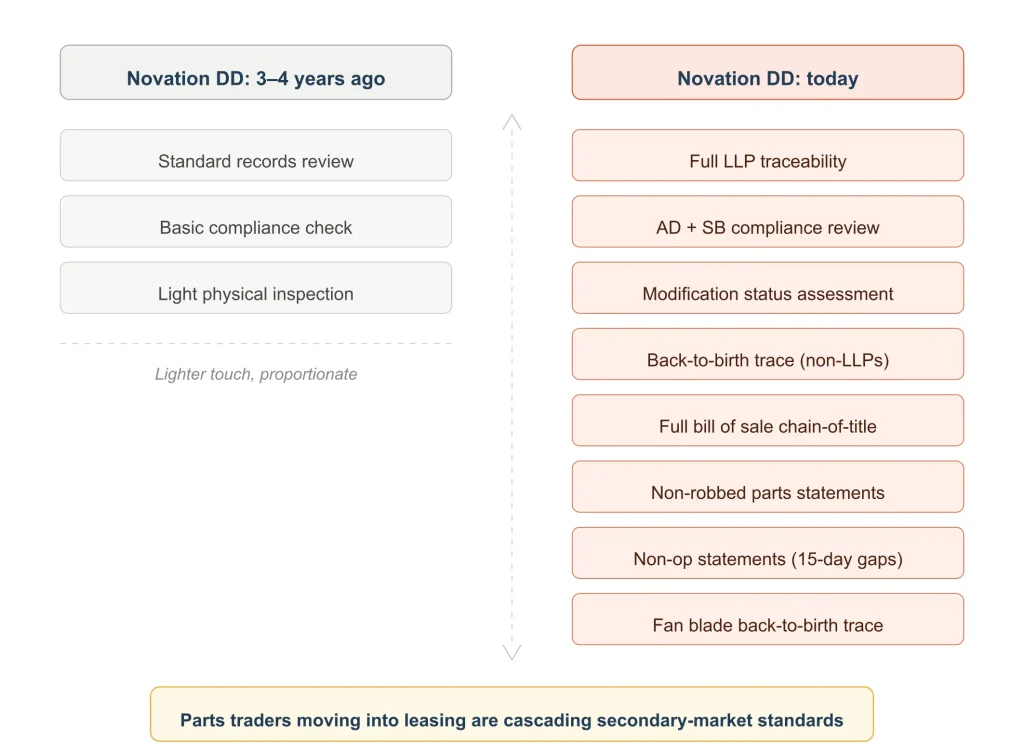
A notable shift in recent years is that mid-lease due diligence increasingly resembles end-of-lease reviews. Three or four years ago, the level of detail requested at novation was lighter. Today, it often includes full LLP traceability, detailed AD and SB compliance reviews, and comprehensive modification status assessments, all on aircraft that remain in active service. That is a fundamentally different workload, and it is a primary driver of extended timelines.
Scope Creep and Expanding Expectations
Buyers are seeking greater technical visibility earlier in transactions. Requests that were historically reserved for redelivery are now being made during novation, often without formal recognition in the commercial framework.
This creates an imbalance. Selling lessors commit to transactions based on defined assumptions, while the technical scope expands during execution. Airlines, in turn, are asked to provide levels of support that may exceed original lease obligations. Without clearly defined boundaries at the outset, scope creep becomes a persistent source of delay.
The Evolution of Records Due Diligence
Records scrutiny has increased significantly. There is now a strong emphasis on completeness and traceability, particularly for engines, landing gear and APUs. Components such as LPT cases and turbine rear frames on CFM56-5B and -7B engines are frequently subject to back-to-birth trace requests, even though they are not life-limited. This represents a significant change from historical practice.
Several factors are driving this shift, but perhaps the most influential is the movement of parts traders up the value chain into the leasing space. These participants bring a different standard of scrutiny, one shaped by the secondary market’s demand for complete traceability. Even where a particular level of trace is not a regulatory requirement, buyers want airtight records to maximise future resale or part-out value. They are hedging against unknowns in a market where future buyers may demand that level of documentation. The logic is understandable, but the cumulative effect on the novation process is substantial.
The scope of what is being requested continues to expand. Non-operational statements are becoming routine even for short periods of downtime; we have seen requests for statements covering periods as brief as fifteen days. Bill of sale traceability has become a major focus: where previously a bill of sale from the most recent owner was sufficient, full chain-of-title trace is now increasingly expected for life-limited parts. Non-robbed parts statements, verifying that a component was not subject to an unapproved parts removal, have also started appearing in standard requests. And fan blade back-to-birth trace is now being demanded despite fan blades not being life-limited components, driven by the concern that future buyers may one day require that level of documentation.
Individually, these requests are understandable. Collectively, they significantly increase the workload associated with due diligence. The challenge for the industry lies in distinguishing between requirements that materially reduce risk and those that have become habitual.
The Checklist Problem
A recurring source of inefficiency is the gap between following a process and understanding the purpose behind it. In too many due diligence exercises, reviewers are working from standardised checklists without a clear grasp of the regulatory or commercial rationale behind each request.
We see this play out regularly. A buyer’s representative requests a back-to-birth trace on a galley oven. No one involved can articulate why that trace is necessary for that component, but it appears on the checklist, so the request is made and the airline is expected to respond. In another case, a retrofit information letter is referenced on a work card, and the reviewer demands a copy of the document despite it having no bearing on the maintenance status of the aircraft. Elsewhere, a non-operational statement is requested for a minor component replacement, perhaps a lavatory smoke detector, simply because the template calls for one.
Each of these may seem minor in isolation. Collectively, they consume significant time and resource without adding any meaningful reduction in risk.
This pattern is particularly pronounced when external consultants are brought in and instructed to identify every possible gap in the records. The consultants follow their process diligently, but without the depth of understanding needed to distinguish between a regulatory requirement, a commercially motivated request, and an item that simply does not matter. The result is that the technical due diligence workstream, the most visible part of the process, becomes burdened with requests that slow the entire transaction.
The most effective due diligence processes are led by individuals who understand both regulatory requirements and commercial priorities. They are able to differentiate between essential and non-essential requests, ensuring that effort is focused where it adds genuine value.
Validation Over Assumption
There has been a clear shift away from relying solely on contractual conditions as an indicator of asset status. Buyers are increasingly seeking to validate the condition of assets during the novation process itself.
This reflects a more cautious and data-driven market, particularly where portfolios contain a mix of well-maintained assets and those with less robust histories. Buyers cannot apply a single level of confidence across the board; they have to test each asset properly. However, this also increases the depth and breadth of due diligence required, particularly when applied across a portfolio of twenty assets rather than one. The scale of the undertaking is very different.
Inconsistent Standards Across the Industry
A lack of standardisation continues to create inefficiencies. Different lessors and buyers apply varying interpretations of what constitutes acceptable records, leading to rework and extended timelines.
Industry initiatives are working towards greater alignment, and there is broadly a consensus on perhaps eighty percent of what should be covered. It is the remaining twenty percent, the areas open to interpretation, that generates much of the friction. Establishing a more consistent baseline would significantly reduce ambiguity and improve efficiency across transactions.
The Airline Perspective
For airlines, the impact of increased due diligence requirements is tangible. Physical inspections must be coordinated around operational schedules, often with limited notice and using the same teams that support daily operations. At the same time, airlines are being asked to produce detailed status reports mid-lease, a requirement historically associated with end-of-lease redelivery, adding to already stretched technical resources.
Encouragingly, some airlines are taking a more proactive approach to records management. Maintaining records in a transaction-ready state not only facilitates novations but also enhances the commercial value of assets and components throughout the lease lifecycle. Records quality is increasingly understood as a commercial differentiator, not just a compliance requirement.
The Legal Dimension
While technical due diligence is the most visible workstream, delays frequently originate on the legal side.
Novations effectively reopen lease agreements, creating opportunities for renegotiation. What should be a straightforward transfer can become a discussion about terms. KYC and compliance processes on new lessors can introduce complications late in the transaction, after significant upstream work on due diligence, draft novation and consent has been completed. We have seen transactions where poor KYC processes meant that a new lessor could not demonstrate minimum net worth requirements, unravelling months of work.
The growing complexity of financial structures is another factor. Lessors are increasingly using sophisticated ownership arrangements, including JOLCOs, ABS facilities, warehouse facilities and multi-entity SPVs, which can be difficult to unwind during a novation. We are aware of aircraft that lessors attempted to novate as far back as 2024 that remain unclosed, with the delays driven almost entirely by the complexity of extracting assets from their financial structures. Multiple entities, lenders and jurisdictions mean more approvals, more layers to work through, and longer timelines.
On the airline side, the growing volume of novations is outstripping in-house legal capacity, leading to greater reliance on external counsel. This changes the pace and dynamics of the consent process. And because the airline made its original deal with a different counterparty, there is a legitimate interest in understanding who the new lessor is and whether they can uphold the terms of the lease. While most of the time the process runs smoothly enough, the airline’s consent is a point of leverage, and the opportunity to address longstanding concerns adds time.
Legal is not confined to a single stage; it runs from start to finish across the entire novation process. The interplay between legal and technical workstreams matters more than many participants recognise. The most efficient transactions are those where both are planned and managed in parallel, with clear communication between them.
Structural Friction
The challenges observed in novations are not the result of poor intent. All parties are aligned in wanting transactions to complete successfully.
Friction arises from the interaction of differing priorities. Lessors focus on capital efficiency, airlines on operational continuity, and buyers on risk mitigation. Each of these perspectives is valid, but they are not always aligned, and the process can only move as fast as the risk allows.
Recognising that this friction is structural rather than behavioural is key to addressing it effectively. The solutions are not about blame or pressure; they are about alignment, communication and preparation.
Reducing Friction: Practical Observations
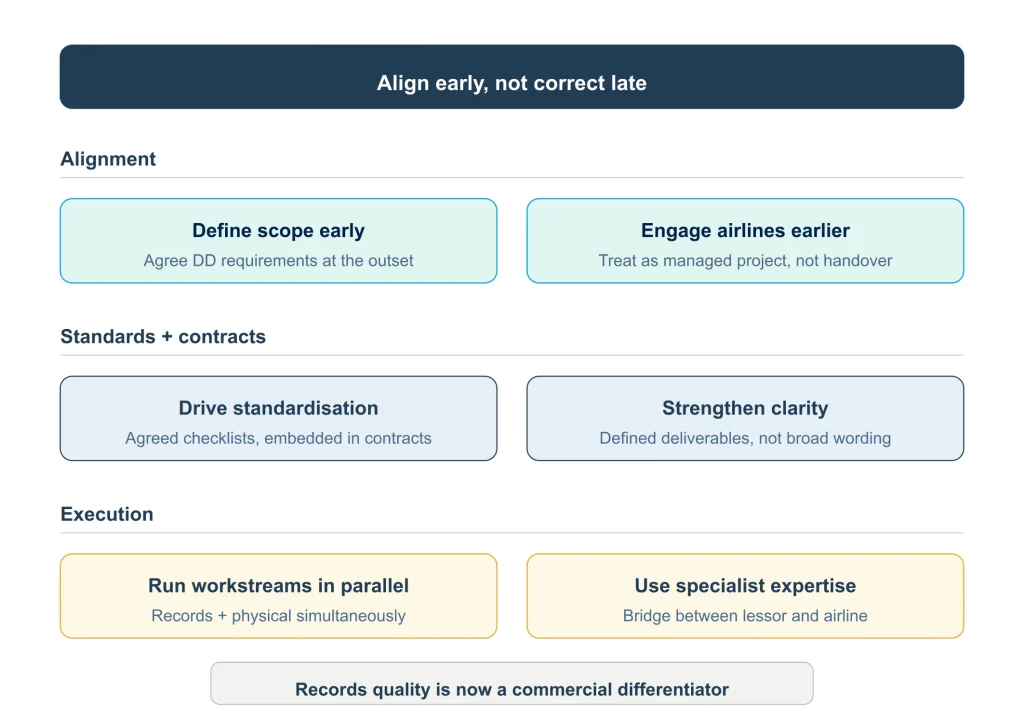
Improving novation efficiency does not require a fundamental redesign of the process. It requires greater alignment and discipline in execution. The focus should be on alignment early, not correction late.
1. Define scope early and maintain it
Due diligence requirements should be clearly agreed at the outset and aligned with the commercial framework. What exactly is being reviewed? What records are required? What does the buyer actually need versus what is being asked for because it sits on a checklist? Where additional requests arise, they should be evaluated and managed formally rather than absorbed into the workstream. Scope creep that is not recognised commercially is one of the most avoidable sources of delay.
2. Engage airlines earlier
Treating the airline as a late-stage participant in a process that fundamentally depends on their cooperation is a recipe for delay. By the time the technical workstream kicks off, the lessor has often already committed to timelines internally. Earlier engagement, with clear expectations around records access, inspection windows and status reporting, allows the airline to plan rather than react. The novation should be treated as a managed project, not a handover.
3. Drive standardisation
Agreed records checklists, embedded contractually and covering structure, trace and delivery format, would remove a significant amount of ambiguity. The industry working groups making progress in this area are doing valuable work, and the eighty percent consensus that already exists is a strong foundation. Closing the gap on the remaining twenty percent would reduce rework, shorten timelines and lower costs for everyone involved. Records quality has become a commercial differentiator: structured, well-maintained documentation closes faster and at better pricing.
4. Strengthen contractual clarity
Leases that include clear, specific obligations around records maintenance, status reporting during the lease term, and cooperation requirements during novation give all parties a shared reference point. Defined deliverables, not broad wording. Specific requirements for periodic status reporting, not assumptions that it will happen when needed. The less that is left to interpretation at the time of the transaction, the less time is spent negotiating what should already be settled.
4. Maintain transaction-ready records
Organisations that treat records as a commercial asset are better positioned for faster transactions and improved asset value outcomes. Airlines that invest in keeping their records current and traceable throughout the lease term benefit not only during novations, but also at end-of-lease redelivery and when selling parts during the operation. In a market where records quality directly influences asset value and transaction speed, the return on that investment is tangible.
5. Run workstreams in parallel
Sequential working, where the records review is completed before the physical inspection begins or vice versa, adds unnecessary time. Where possible, physical and records workstreams should run in parallel, with findings from each informing the other in real time. This requires planning and coordination, but the time savings can be significant.
6. Use specialist expertise where appropriate
Experienced technical and records support can act as a bridge between lessor and airline, bringing structure and consistency to the process. When engaged early enough, specialist providers can shape the due diligence scope, set the records request in a sensible way, and avoid overwhelming the airline from the outset. The value lies not in adding another layer of process, but in having people involved who understand the regulatory requirements, the commercial drivers and the operational constraints, and who can navigate between them.
Looking Ahead
The factors driving increased novation activity are expected to persist. Delivery volumes are rising, trading activity is increasing, M&A is adding momentum, and lease cycles are normalising. At the same time, transaction complexity continues to grow, novation timelines are lengthening, and expectations around due diligence have shifted permanently.
The central challenge remains one of alignment. Records have moved from being a compliance requirement to being a commercial asset. Parts trader demands, while individually logical, are cascading through the system with no regulatory basis and creating a hidden driver of delay that the industry has not yet fully come to terms with. The timeline gap between what lessors plan for and what can realistically be achieved is real and widening.
In practical terms, what consistently makes a difference is a combination of early alignment and disciplined execution: standardisation where it can be achieved, earlier engagement with airlines, clearer contractual frameworks, and maintaining records in a transaction-ready state. Organisations that approach novations in this way tend to spend less time managing friction and more time progressing transactions with confidence.
As novation activity continues to scale, there is also an increasing role for experienced technical partners who can help structure and manage due diligence in a way that is proportionate, efficient and aligned across all parties. Where that support is applied early and thoughtfully, it can help reduce unnecessary burden on airlines while maintaining the level of rigour the market now expects.
More information on how Shannon Technical Services supports these workstreams can be found at shannontechservices.com
About Shannon Technical Services
Shannon Technical Services is a global aviation technical services provider, delivering turnkey technical support to aircraft lessors and airlines in over 60 countries. Headquartered in Shannon, Ireland, with offices in Malta and Singapore, STS provides CAMO management, Part 21 design and engineering, transition management, technical representation and records hub services, engine management and borescope inspection, materials procurement and logistics, leased managed services, and technical inserts and structural specialist support.
Market data referenced in this article is sourced from IBA Insight, the aviation intelligence platform provided by IBA Group. IBA is a world-leading aviation intelligence and advisory company. For more information, visit iba.aero.
Join Our Newsletter
Subscribe to receive our latest updates in your inbox!